






“Regulations on Filing and Review of Regulations and Rules” Lays the Cornerstone for the Modern Tax Law System
 April 28, 2026, 2:39 p.m.
2737Views
April 28, 2026, 2:39 p.m.
2737Views
Liu Tianyong
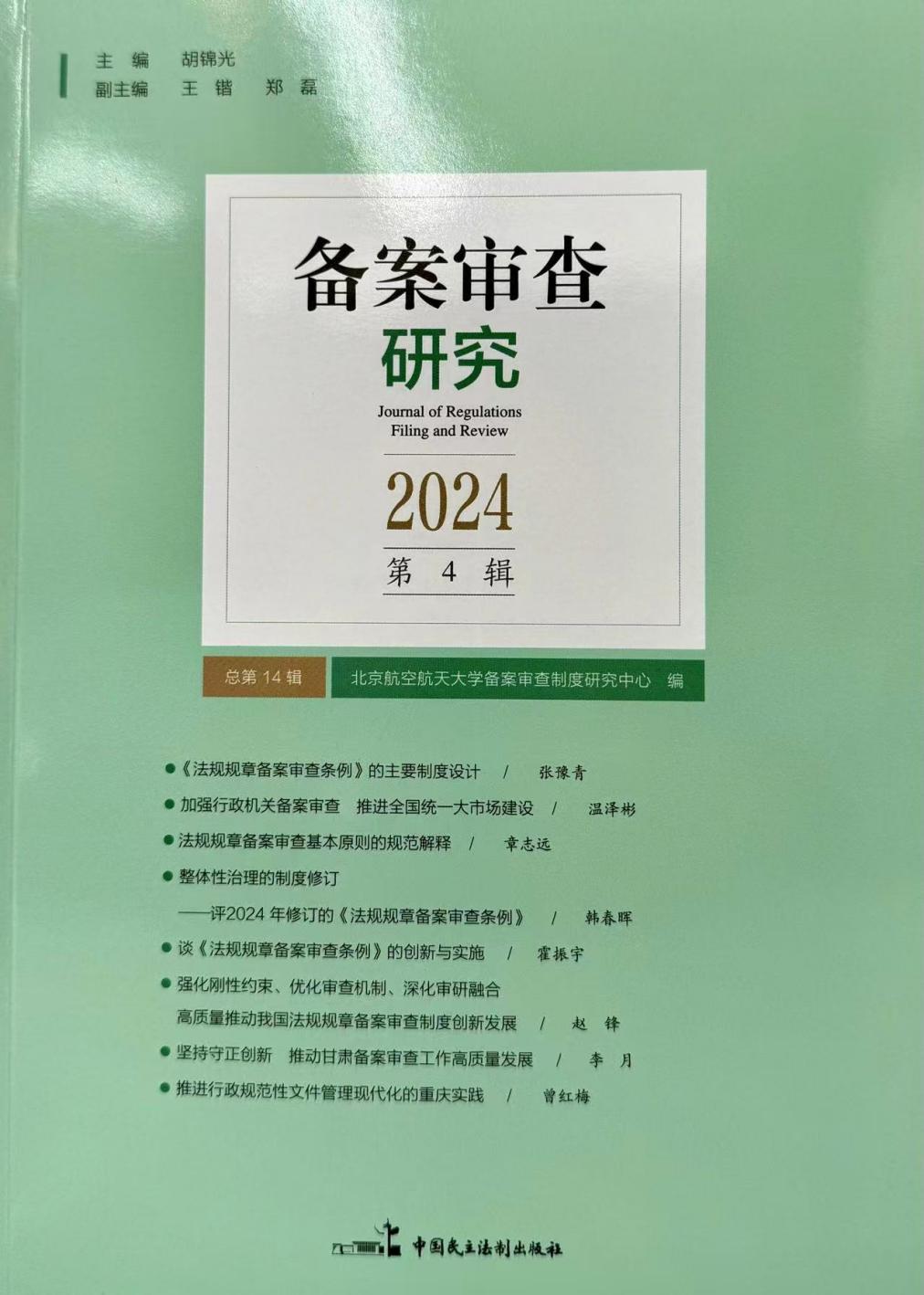
Since the Third Plenary Session of the 18th Central Committee of the Communist Party of China, China has accelerated the legislative process for tax law and has established a relatively complete tax law system. However, owing to the complexity and professionalism of tax collection and administration, as well as disparities in economic development levels across different regions, there remain certain mismatches among laws and regulations, departmental rules, local regulations, and the vast body of tax normative documents. In 2024, the State Council comprehensively revised the Regulations on Filing of Regulations and Rules promulgated in 2001, introducing the Regulations on Filing and Review of Regulations and Rules (hereinafter referred to as "the Regulations"), which officially took effect on November 1. The Regulations enhance supervision over rules and local regulations, and are of great significance for maintaining the unity of the tax legal system and advancing the modernization of tax rule of law.
I. China's Tax Legal System Has Been Initially Established, but Conflicts Still Exist Among Individual Norms
Following the adoption of the Value-Added Tax Law of the People's Republic of China on December 25, 2024, among the 18 currently effective tax categories in China, 14 have completed their legislative work, and the modern tax law system has been essentially perfected. However, given the complexity of tax law norms, laws and administrative regulations often find it difficult to cover all specific issues. Accordingly, China's various tax categories have generally formed a multi-tiered normative system structured as "laws + implementing regulations + tax departmental rules + tax normative documents." Taking individual income tax as an example, the Individual Income Tax Law of the People's Republic of China and its Implementing Regulations constitute the foundational legal and regulatory framework, while specific collection and administration details are supplemented by multiple departmental rules—such as the Interim Measures for the Collection and Administration of Individual Income Tax in the Advertising Market and the Interim Measures for the Collection and Administration of Individual Income Tax on Foreign-Source Income—along with a large number of tax normative documents that refine operational procedures. In order to implement the principle of statutory taxation, the Ministry of Finance and the State Administration of Taxation (SAT) have made significant progress in systematic development by revising departmental rules and normative documents. Nevertheless, in actual operation, three types of coordination problems persist: (1) coordination issues between tax departmental rules and tax laws and administrative regulations; (2) coordination issues between normative documents formulated by the SAT and higher-level laws; and (3) coordination issues between normative documents formulated by local governments and local tax authorities and higher-level laws.
These problems have impeded the effective implementation of the principle of statutory taxation and hindered the construction of a modern tax law system. The introduction of the Regulations refines the filing and review mechanism for rules and local regulations, strengthens supervisory measures, and is conducive to improving the existing tax law system, enhancing the efficiency of tax collection and administration, and increasing taxpayer compliance.
II. The Regulations Refine the Filing and Review Mechanism and Strengthen Review Measures for Regulations
Article 2 of the Regulations specifies that the scope of filing and review covers local regulations, departmental rules, and local government rules. Under the former Regulations on Filing of Regulations and Rules, the State Council's legislative institution conducted only formal reviews of submitted regulations and made filing registrations; review proceedings were initiated only upon receipt of written review recommendations from state agencies, social organizations, enterprises and institutions, or citizens. This approach confined filing and review to a passive state. When the Legislation Law of the People's Republic of China was amended in 2015, mechanisms for "active review" and "special review" were added, but specific operational procedures were lacking. The current Regulations provide that departmental rules of State Council departments must be submitted to the State Council for filing within 30 days from the date of promulgation, and the State Council filing and review working body must conduct active review within 2 months, and may conduct special reviews and joint reviews as needed. This enables filing and review to proactively identify and correct potential problems, effectively implementing the principle that "all filed documents must be reviewed."
From the perspective of the scope of filing and review under the Regulations, the most significant impact on the tax law field lies in strengthening supervision over tax departmental rules. Tax law issues are in particular often complex and highly technical, involving coordination and cooperation among multiple departments. Through special reviews and joint reviews, in-depth and detailed inspections of specific departmental rules can be conducted, integrating resources and expertise from all relevant parties, which is of great significance for improving the quality and implementation effects of tax policies.
In addition, Article 15 of the Regulations provides that the State Council filing and review working body, when reviewing regulations and rules, may extensively solicit opinions from state agencies, social organizations, enterprises and institutions, experts and scholars, and interested parties through various forms such as symposiums, demonstration meetings, hearings, commissioned research, and field investigations, while giving full play to the role of the expert committee on filing and review. Since tax departmental rules are directly related to the vital interests of every taxpayer, extensively soliciting opinions can enhance the scientific rigor and democratic character of the review process, increase taxpayer participation in decision-making, and foster public trust. At the same time, leveraging the knowledge and experience of external tax law experts to provide constructive improvement suggestions grounded in practical conditions can improve the quality and efficiency of reviews.
At present, the legislative work on customs duties and value-added tax has been completed successively, and the revision of the Tax Collection and Administration Law of the People's Republic of China has been incorporated into the State Council's 2024 annual legislative work plan, making the related supporting tax and customs regulations particularly critical. The introduction of the Regulations comes at an opportune moment, providing an important legal basis and supporting framework for the formulation and revision of regulations in these fields, and will greatly promote the construction of the modern tax law system.
III. The Regulations Facilitate the Cleanup of Tax Normative Documents and Advance Systematic Development
In the current tax law system, the most numerous and fundamentally important are the tax normative documents formulated by the SAT and local tax authorities. The Measures for the Administration of the Formulation of Tax Normative Documents (SAT Order No. 53) define tax normative documents as tax documents formulated and issued by tax authorities at and above the county level, with an effectiveness level below departmental rules, that have general binding force and are repeatedly applicable within a certain period. Their primary purpose is to refine and implement tax laws, administrative regulations, and departmental rules.
Although tax normative documents do not fall within the scope of filing and review prescribed by the Regulations, they remain within the scope of review upon application. Article 12 of the Regulations provides that if state agencies, social organizations, enterprises and institutions, or citizens consider that local regulations, rules, and "other administrative decisions and orders with general binding force" conflict with laws or administrative regulations, they may submit written review recommendations to the State Council. The State Council filing and review working body will study the matter and put forward handling opinions, to be processed according to prescribed procedures. Accordingly, normative documents are brought within the scope of review through the review-upon-application system.
In the tax law system, conflicts between tax normative documents and tax laws and administrative regulations are mainly manifested at two levels: conflicts in the hierarchy of legal effectiveness and deviations in policy interpretation. Conflicts in the hierarchy of effectiveness primarily occur during periods of institutional reform, when specific authorized tax normative documents may have an effectiveness level even higher than administrative regulations. A typical example arose during the comprehensive rollout of the reform replacing business tax with value-added tax: the Notice of the Ministry of Finance and the State Administration of Taxation on the Comprehensive Rollout of the Pilot Program for Replacing Business Tax with Value-Added Tax (Cai Shui [2016] No. 36), which stood at the core of the VAT regulatory system, temporarily displaced the implementation of the Provisional Regulations on Value-Added Tax, yet its level of legal effectiveness was not high. After the reform was completed at a certain stage, the relevant reform outcomes were absorbed into tax laws and administrative regulations. It should be noted, however, that similar reforms should follow the provisions of the Legislation Law of the People's Republic of China by properly carrying out authorized legislation, so as to avoid conflicts in the hierarchy of legal effectiveness.
More impactful for taxpayers are conflicts caused by deviations in policy interpretation. Tax laws and administrative regulations are often formulated based on macro-level legislative objectives, while tax normative documents need to specify operational rules. If tax authorities excessively extend or distort higher-level laws in the interpretation process, contradictions may arise. For example, Article 8 of the Enterprise Income Tax Law of the People's Republic of China and Article 27 of its Implementing Regulations provide that reasonable expenditures actually incurred by enterprises in connection with the generation of revenue may be deducted before tax, emphasizing three principles: authenticity, reasonableness, and relevance. However, Article 6 of the Notice of the State Administration of Taxation on Issuing "Several Specific Measures to Further Strengthen Tax Collection and Administration" and Article 12 of the Administrative Measures for Pre-Tax Deduction Vouchers for Enterprise Income Tax require that costs may be deducted only when enterprises obtain legally valid pre-tax deduction vouchers, prohibiting the use of non-compliant invoices and other external vouchers. This means that even if an enterprise's expenditures are genuine and reasonable, if it fails to obtain vouchers meeting the prescribed requirements, it must still make supplementary tax payments. These normative documents facilitate the execution and operation of tax authorities, but they increase taxpayers' obligations and restrict their right to pre-tax deductions as provided by law, giving rise to contradictions with higher-level laws.
Deviations in policy interpretation can lead to different handling outcomes for similar cases across different regions, undermining the fairness and predictability of taxation. For instance, in the past some local tax authorities recognized enterprises' deductions of genuine and reasonable cost expenditures based on self-prepared vouchers, while others categorically denied the legality of self-prepared vouchers. At the same time, taxpayers must navigate multiple layers of rules, significantly increasing compliance costs; the slightest misstep may result in the risk of supplementary tax payments, late payment interest, or even administrative penalties. Finally, such policy conflicts substantially increase the number of administrative disputes, with enterprises and tax authorities consuming significant resources in reconsideration proceedings and litigation.
Although the Measures for the Administration of the Formulation of Tax Normative Documents provide for filing and review procedures, systematic oversight is still lacking in practice. To effectively resolve conflicts, it is necessary to organically combine the filing and review under those Measures with the review-upon-application system under the Regulations, further strengthening the binding force of the review system, and ultimately achieving the unity and authority of the tax legal system.
IV. The Regulations Strengthen the Cleanup of Local Tax Havens and Build a Unified National Market
In the past, certain localities, in order to attract investment, unilaterally introduced policies of tax rebates or industry-specific exemptions, creating conflicts with substantive tax laws such as the VAT and enterprise income tax laws. Such conflicts not only violate the principle of statutory taxation but also distort the market competition environment, leading to misallocation of resources. For example, if renewable resource recycling enterprises gain additional advantages from local tax preferences, they may crowd out similar enterprises in other regions, hindering the formation of a unified national market. Since 2024, audit, tax, and National Development and Reform Commission (NDRC) departments have issued documents requiring strict investigation of non-compliant fiscal rebates. The State Council promulgated the Fair Competition Review Regulations, which came into effect on August 1, 2024, providing a pathway for the cleanup of local fiscal rebate policies. When the person in charge of the Ministry of Justice answered reporters' questions concerning the Regulations, it was also emphasized that future efforts will focus on issues affecting the unified national market and undermining the business environment, strengthening the filing and review of and research into regulations in key areas such as fair competition, and working hard to break down local protectionism and market segmentation, thereby contributing to the construction of a unified national market and the optimization of the business environment.
Accordingly, industries and sectors operating on the basis of fiscal rebates will face transformation, particularly the flexible employment industry, the logistics and transportation industry, and the renewable resources industry. Flexible employment platforms, which serve as a bridge connecting client enterprises with flexible workers, have demonstrated vigorous growth in recent years. However, most flexible employment platforms rely on fiscal rebates from local governments to generate profits, using below-cost pricing to expand market share and strengthen competitiveness. The logistics and transportation industry and the renewable resources recycling industry mainly face the problem that individual persons providing freight services or selling waste materials are unwilling to issue the "first invoice," resulting in higher tax burden costs for enterprises. Various provinces have also successively introduced policies in various forms—such as government incentive funds—to attract the establishment of flexible employment platforms, freight platforms, and renewable resource recycling enterprises and to support their development.
With the cleanup of local fiscal and tax policies, local governments are now urgently adjusting provisions on fiscal rebates and other matters, exploring and reformulating local regulations and local government rules to support the development of the flexible employment, logistics and transportation, and renewable resources industries. It is foreseeable that as the Regulations are implemented, local governments will face increasingly stringent filing and review scrutiny when introducing regulations supporting industrial development through subsidies and other means. A large number of enterprises in the flexible employment, logistics and transportation, and renewable resources sectors that rely on government support for development will face major challenges and pressures arising from filing and review requirements, and should actively prepare for transformation and development, exploring paths toward sustainable growth.
V. Summary
The introduction of the Regulations is of great value and significance for the construction of the tax legal system. The Regulations not only strengthen the review and supervision of tax regulations and rules, which is conducive to improving the quality of tax legislation, but also—together with the Fair Competition Review Regulations—reinforce constraints on local governments in formulating tax policies, maintaining a fair competition environment in the unified national market. Although the Regulations primarily target rules and local regulations, Article 12, through the "review-upon-application" mechanism, indirectly covers tax normative documents, thereby complementing the Measures for the Administration of the Formulation of Tax Normative Documents. It is therefore hoped that the Regulations will be better coordinated and aligned with those Measures to improve the coordination mechanism for tax laws and regulations, reduce conflicts between legal norms at different levels, ensure the effective implementation of tax policies, adapt to the needs of economic and social development, assist in the new round of fiscal and tax system reform, and consolidate the legal foundation for the modernization of tax governance.


